


Camphene (CAS 79-92-5) is a bicyclic monoterpene that occurs naturally in the essential oils of plants such as pine, cypress, rosemary, ginger and orange blossoms(neroli).
It is an isomer of pinenes (alpha-pinene and beta-pinene) and limonene. Although it shares the same molecular formula (C10H16) with these aromatic chemicals, the arrangement of its molecular structure gives it distinct organoleptic properties and makes it the only member of the group that occurs as a crystalline solid at room temperature, with a melting point of around 48–52 °C.
Its name derives from the Latin camphora, reflecting its close relationship with camphor, a semi-solid, crystalline aromatic compound that can be produced on an industrial scale through the oxidation of camphene itself.
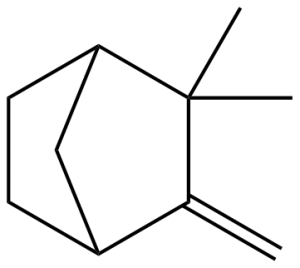
| AROMATIC PROFILE |
|---|
| Camphoraceous · Woody · Balsamic · Fresh · Herbal · Pungent · Piney · Resinous · Earthy |
In nature, it contributes to the classic scent of damp pine needles that can be perceived when walking through dense coniferous forests in the early morning.
Camphene Production Methods
Although camphene can be obtained by extraction from the essential oils that contain it, its concentration in these oils is generally low, making this method unviable for meeting the high levels of industrial demand.
For this reason, camphene is currently produced mainly through the catalytic isomerization of α-pinene, a monoterpene that is abundant in turpentine, a 100% renewable raw material obtained from pine resin.
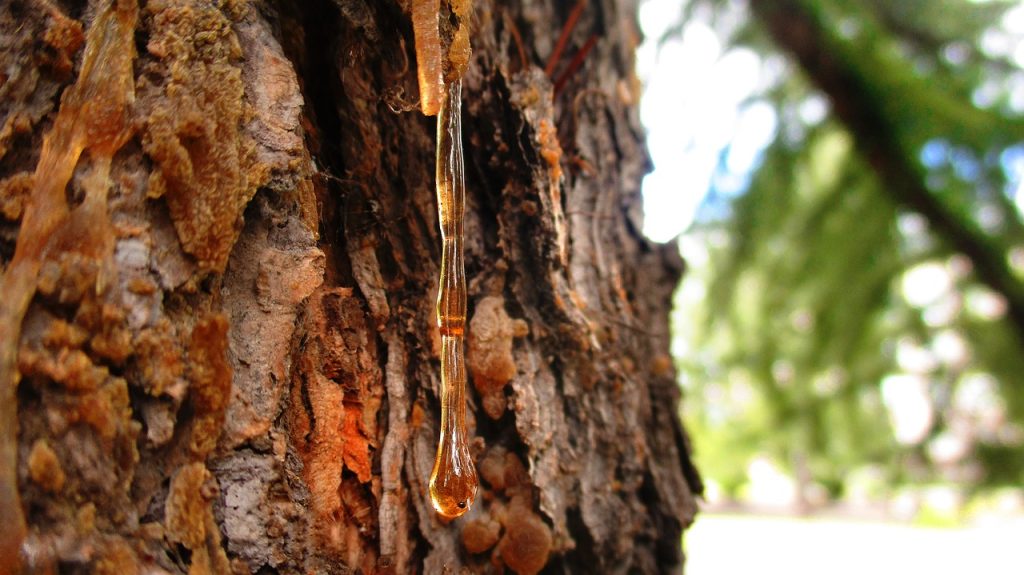
This process is an excellent example of green chemistry, making use of a sustainable forestry resource without relying on petrochemical sources.
A Brief History of Camphene
The history of camphene is closely linked to the search for alternatives to whale oil as a fuel for domestic lighting.
In the 1830s, camphine lamps began to gain popularity. These oil lamps predated kerosene lamps and were designed to burn rectified turpentine.
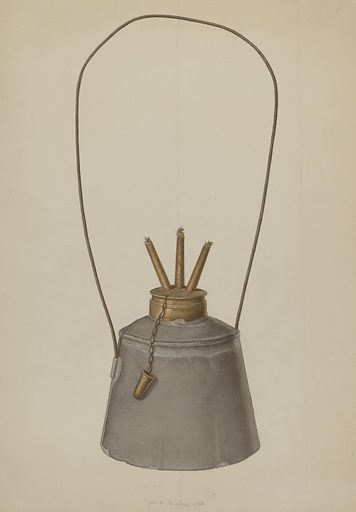
Watercolor and graphite illustration by Jacob Gielens (1938).
Public domain (NoC US 1.0).
Source: National Gallery of Art, Washington, D.C.
In the English-speaking world, this fuel was also marketed under the name camphene, a term that is now used for camphene in English and derives from the Latin camphora.
The widespread use of turpentine and its derivatives prompted 19th-century chemists to study its composition in depth. It was in this context that Marcellin Berthelot eventually isolated, characterized and formally named camphene as the pure molecule known today.
Berthelot was also the scientist who demonstrated in 1870 that authentic camphor could be obtained from camphene. This discovery represented a major advance in organic chemistry and paved the way for the subsequent development of methods to produce this valuable compound without the need to import the expensive natural variety extracted from the Asian tree Cinnamomum camphora.
Camphene Applications in Modern Industry
Today, due to its olfactory profile, camphene is used directly in perfumery to provide pine-needle nuances and as a flavouring agent in the food industry.
It is also highly relevant to industry as a raw material, serving as an intermediate in the industrial synthesis of borneol, isoborneol, isobornyl acetate and camphor itself.
Another application of camphene is the production of 100% renewable synthetic terpene resins, which can replace petrochemical derivatives in coatings, varnishes and adhesives.
In the medical field, camphene is used as an adjunct in treatments for urolithiasis (the elimination of kidney stones) , while numerous studies have investigated its potential pharmacological applications. These include research into its potential hypolipidemic effect , anti-inflammatory activity , antioxidant activity and expectorant properties .
Why Choose Our Camphene?
At DMG, we guarantee that our camphene is produced through a solvent-free manufacturing process using turpentine derived from pine resin.
From this 100% renewable raw material, we manufacture the levo-camphene isomer. Thanks to our quality management system, we ensure compliance with our product specifications, including olfactory consistency from batch to batch.
We offer a wide range of grades suitable for applications including perfumery, cosmetics, air care and food flavourings.
Our camphene also complies with the European REACH Regulation, ensuring full regulatory traceability and an up-to-date Safety Data Sheet (SDS). We also provide the documentation and IFRA certification required to ensure efficient and safe formulation for perfumery, cosmetics and personal care applications.
Interested in working with our camphene or would you like more information? Contact us with no obligation.


